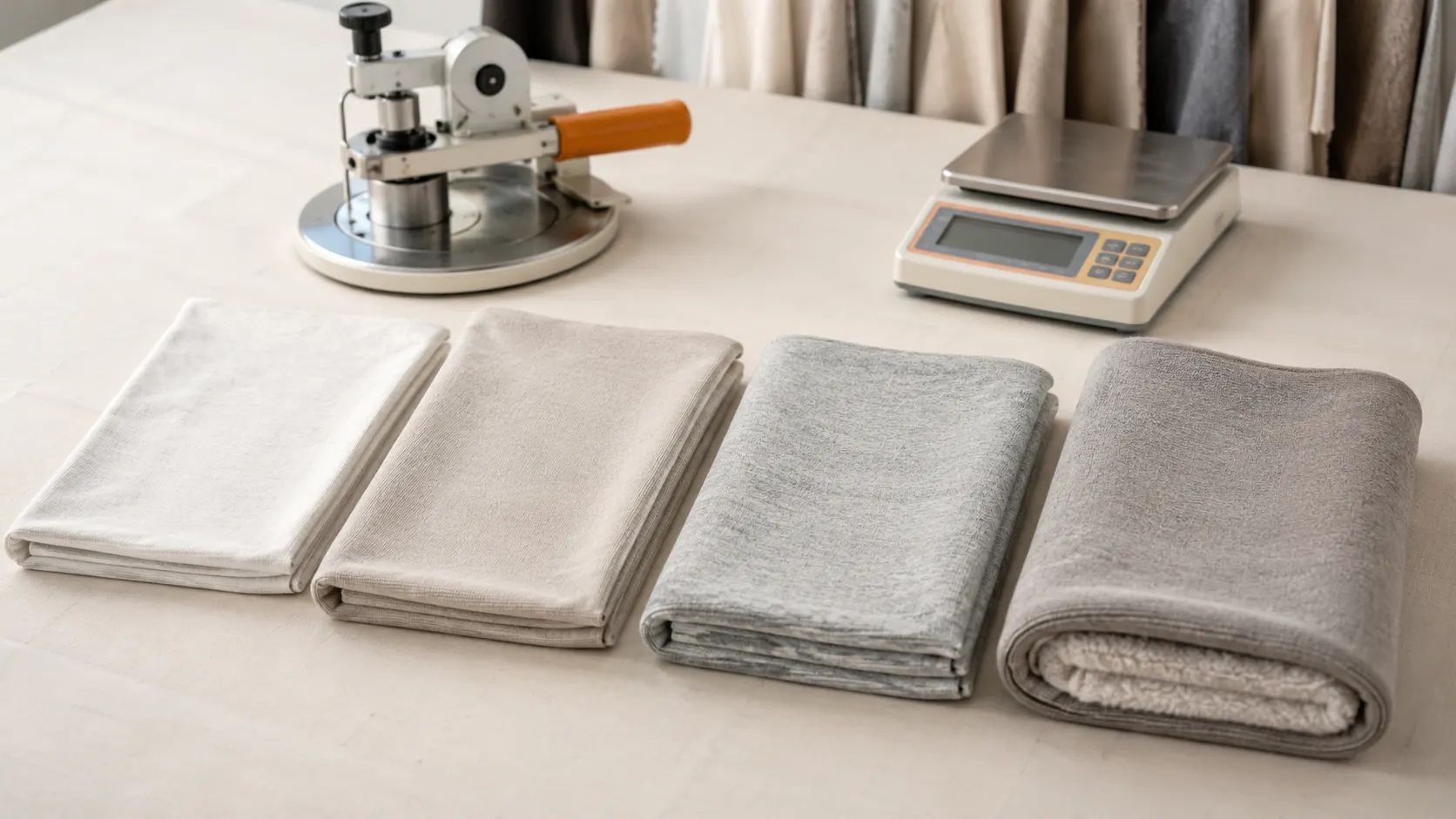
What Is Fabric GSM? Complete Guide to Fabric Weight for Clothing
If you are developing a T-shirt, hoodie, sweatshirt, tracksuit or almost any other garment, fabric GSM is one of the specifications you are likely to encounter.
But what does GSM actually mean, and does a higher number mean better fabric?
GSM stands for grams per square metre (g/m²). It measures the mass of a fabric over an area of one square metre. In simple terms, it tells you how light or heavy a fabric is for a given area.
For example, a fabric specified as 220 GSM weighs approximately 220 grams per square metre.
GSM is useful when comparing fabrics, but it does not tell you everything about a material. Two fabrics with exactly the same GSM can have different thickness, softness, stretch, warmth, drape, durability and overall quality.
This guide explains what fabric GSM means, common GSM ranges for clothing, how it affects T-shirts and hoodies, and what clothing brands should consider before selecting a fabric weight.
Fabric GSM at a Glance
| Fabric GSM | General Weight | Common Clothing Applications |
|---|---|---|
| Below 130 GSM | Very lightweight | Linings, lightweight performance fabrics |
| 130–160 GSM | Lightweight | Summer tees, lightweight tops |
| 160–200 GSM | Light–medium | Everyday T-shirts |
| 200–250 GSM | Medium–heavy | Premium and heavyweight T-shirts |
| 250–300 GSM | Heavy for jersey | Heavy tees, lighter sweat garments |
| 300–400 GSM | Heavyweight | Hoodies, sweatshirts, tracksuits |
| 400–500+ GSM | Very heavyweight | Heavyweight hoodies and streetwear |
Important: These ranges are useful references, not universal quality standards. Fabric construction, composition, yarn and finishing must also be considered.
What Does GSM Mean in Fabric?
GSM means grams per square metre.
The basic calculation is:
GSM = fabric weight in grams ÷ fabric area in square metres
If one square metre of fabric weighs 250 grams, the fabric is 250 GSM.
This provides clothing designers, buyers and manufacturers with a standardized way of discussing fabric weight.
Instead of saying:
“I want a fairly heavy T-shirt fabric.”
a specification can state:
“100% cotton single jersey, target 250 GSM.”
That gives the manufacturer considerably more useful information.
However, even that specification can be improved further by defining the required finish, hand feel, color, shrinkage expectations and other characteristics.
Does Higher GSM Mean Thicker Fabric?
Often, but not always.
GSM measures mass per unit area, whereas thickness is a separate physical characteristic.
Fabric thickness is influenced by factors such as:
- fiber type
- yarn count and construction
- knitting or weaving structure
- fabric density
- brushing or raising
- finishing
- compacting
- fiber bulk
For example, a brushed fleece can feel significantly thicker and bulkier than a compact fabric with a similar GSM.
So it is better to remember:
GSM tells you fabric weight — not exact fabric thickness.
If thickness is critical to a garment, evaluate the physical fabric as well as its GSM specification.
Does Higher GSM Mean Better Quality?
No. Higher GSM does not automatically mean higher quality.
This is one of the most common mistakes when comparing clothing fabrics.
Consider two cotton jersey fabrics that both measure approximately 220 GSM.
Fabric A might have:
- consistent knitting
- quality yarn
- a smooth surface
- good colorfastness
- controlled shrinkage
- low pilling
- a comfortable hand feel
Fabric B could also be 220 GSM while performing poorly in several of those areas.
Both fabrics meet the same weight specification, but they are not necessarily the same quality.
Fabric quality should be assessed using more than GSM
Depending on the garment, relevant factors can include:
- fiber composition
- yarn quality
- knit or weave construction
- dimensional stability
- shrinkage
- pilling resistance
- colorfastness
- stretch and recovery
- surface appearance
- finishing
- hand feel
- durability
GSM is one specification within the complete fabric specification.
What GSM Is Good for T-Shirts?
There is no single GSM that is best for every T-shirt.
The right weight depends on the intended fit, season, market, fabric construction and desired hand feel.
A practical starting point is:
| T-Shirt GSM | Typical Character |
|---|---|
| 130–160 GSM | Lightweight |
| 160–180 GSM | Standard/light-medium |
| 180–220 GSM | More substantial |
| 220–250 GSM | Heavyweight |
| 250+ GSM | Very heavyweight/structured |
160–180 GSM T-shirts
This range can work well for lighter everyday T-shirts where the goal is comfort without excessive fabric weight.
Possible applications include:
- summer clothing
- everyday basics
- regular-fit tees
- promotional apparel
- lightweight collections
180–220 GSM T-shirts
This range can provide more substance while remaining versatile.
It is often worth considering for:
- premium basics
- casualwear
- relaxed-fit T-shirts
- midweight streetwear
220–250 GSM T-shirts
For comparable fabric constructions, this range creates a noticeably more substantial garment.
It can work particularly well for:
- heavyweight tees
- oversized T-shirts
- boxy silhouettes
- streetwear collections
- garments intended to have more structure
Stitch Expo’s current custom T-shirt manufacturing collection includes customizable T-shirt options across different fabrics, fits and weights.
250+ GSM T-shirts
250 GSM and above can be appropriate for very heavyweight T-shirts.
But heavier does not automatically mean better.
If the goal is a lightweight summer tee, increasing the GSM simply to make the product appear “premium” can work against the intended comfort and drape.
180 GSM vs 220 GSM vs 250 GSM
This is one of the most useful comparisons for brands developing cotton T-shirts.
| Specification | 180 GSM | 220 GSM | 250 GSM |
|---|---|---|---|
| General feel | Lighter | Substantial | Heavyweight |
| Structure | Lower | Medium | Higher |
| Summer suitability | Generally stronger | Depends on construction | Usually heavier |
| Oversized streetwear | Possible | Very suitable | Very suitable |
| Fabric consumption by weight | Lower | Higher | Higher |
| Best choice | Depends on design | Depends on design | Depends on design |
The key point is that 180, 220 and 250 GSM are not quality grades.
They are different fabric weights.
When our dedicated 180 GSM vs 220 GSM vs 250 GSM T-Shirts article is published, this section should link directly to it.
Is 250 GSM Good for a T-Shirt?
Yes, 250 GSM can be an excellent choice for a heavyweight T-shirt, especially for oversized, boxy and streetwear-oriented garments.
A 250 GSM cotton jersey can help create:
- a more substantial hand feel
- additional garment structure
- a heavier drape
- a premium heavyweight appearance
However, the finished result depends on the actual fabric.
A specification such as:
100% cotton single jersey, approximately 250 GSM
is much more meaningful than simply requesting a “premium heavyweight fabric.”
For brands developing custom products, Stitch Expo’s T-shirt manufacturing options allow the fabric, fit, color and decoration to be customized around the product specification.
What GSM Is Good for Hoodies?
Hoodies normally use heavier materials than T-shirts.
Common hoodie fabrics include:
- French terry
- brushed fleece
- cotton/polyester fleece
- loopback jersey
- interlock
- heavyweight cotton fleece
A broad reference is:
| Hoodie GSM | General Character |
|---|---|
| 220–280 GSM | Lightweight |
| 280–350 GSM | Midweight |
| 350–450 GSM | Heavyweight |
| 450+ GSM | Very heavyweight |
These ranges are not strict standards.
A 350 GSM French terry and 350 GSM brushed fleece can feel significantly different because their structures and finishes are different.
Stitch Expo’s custom hoodie manufacturing guide currently covers French terry, brushed fleece, interlock and other hoodie materials across different weight ranges.
Is 300 GSM Good for a Hoodie?
Yes, 300 GSM can be suitable for a lighter or midweight hoodie, depending on the fabric construction and intended use.
It can make sense when the goal is:
- less bulk
- transitional-season clothing
- a lighter sweatshirt feel
- warmer-climate use
For a substantial heavyweight streetwear hoodie, a brand may prefer a heavier material.
But again, GSM should not be chosen independently of the fabric construction.
Is 400 GSM Good for a Hoodie?
400 GSM can be an excellent starting point for a heavyweight hoodie.
For an appropriate fleece or French terry construction, this weight can produce a substantial garment suitable for premium casualwear and streetwear.
Stitch Expo currently manufactures heavyweight hoodies with customizable fabric, GSM, fit, construction, decoration and branding through its custom hoodie manufacturing service.
However:
400 GSM alone does not make a hoodie premium.
The yarn, composition, knitting, brushing, shrinkage, rib quality, construction and finishing still matter.
What About 450–500 GSM Hoodies?
450–500 GSM sits firmly in very-heavyweight territory for many sweatshirt fabrics.
These weights can be useful for garments intended to feel:
- dense
- substantial
- structured
- warm
- deliberately heavyweight
But very heavy fabrics create their own development considerations.
For example, the garment’s:
- seams
- hood construction
- ribbing
- pockets
- zipper
- pattern
- drape
all need to work with the material.
Selecting a very high GSM simply because it sounds premium is therefore not a good product-development strategy.
GSM vs Fabric Composition
GSM and composition tell you different things.
GSM tells you:
How much the fabric weighs per square metre.
Composition tells you:
Which fibers make up the fabric.
Examples include:
- 100% cotton
- 100% polyester
- cotton/polyester
- cotton/elastane
- polyester/elastane
- nylon/elastane
Consider:
220 GSM 100% cotton single jersey
versus
220 GSM polyester/elastane performance knit
Both may weigh 220 grams per square metre, but they can behave completely differently.
That is why a proper fabric specification should include both GSM and composition.
GSM vs Fabric Construction
Construction is equally important.
Common clothing fabric constructions include:
- single jersey
- interlock
- rib
- French terry
- fleece
- piqué
- mesh
- twill
- ripstop
For example:
250 GSM single jersey
and
250 GSM interlock
have the same stated fabric weight but different constructions.
Their stability, surface, stretch behavior, drape and hand feel may therefore differ.
Our upcoming Single Jersey vs Interlock Fabric guide will explain this comparison in detail.
French Terry vs Fleece: Does GSM Mean the Same Thing?
The measurement itself means the same thing: grams per square metre.
The physical result, however, does not.
French terry typically has loops on its reverse side, whereas brushed fleece is processed to create a softer, raised interior surface.
Consequently, two fabrics with a similar GSM can have noticeably different:
- bulk
- warmth
- softness
- surface structure
- hand feel
This is why hoodie development should consider both fabric type and GSM.
Our upcoming French Terry vs Fleece guide will cover this specifically.
Does Higher GSM Make Clothing Warmer?
It can contribute to warmth, but GSM alone cannot predict thermal performance.
Warmth can also depend on:
- fiber type
- construction
- thickness
- trapped air
- brushing
- layering
- garment design
A bulky brushed material may trap more air than a dense, compact material of similar weight.
So:
Higher GSM ≠ automatically warmer in every comparison.
Does Lower GSM Mean More Breathable?
Not necessarily.
Lower fabric weight can reduce bulk, which may be desirable for warm-weather clothing, but breathability also depends on:
- fiber
- yarn
- fabric structure
- openness
- density
- finishing
- moisture-management properties
A tightly constructed lightweight synthetic fabric and an open lightweight cotton knit can perform differently.
Does Higher GSM Make Fabric More Durable?
Not automatically.
Durability depends on factors such as:
- fiber strength
- yarn quality
- construction
- abrasion resistance
- pilling
- seam construction
- finishing
- intended use
A heavier fabric made poorly is not necessarily more durable than a lighter fabric engineered for its application.
Does GSM Affect Fabric Cost?
It can.
For otherwise comparable fabrics, a higher GSM generally means more material mass is used per unit area.
However, fabric cost is also influenced by:
- fiber
- yarn
- construction
- dyeing
- finishing
- quantity
- color
- treatments
- sourcing conditions
Therefore, you cannot accurately price a fabric from GSM alone.
Two 250 GSM fabrics can have very different costs.
Does GSM Affect Printing?
GSM can influence the way a garment behaves during decoration, but printing compatibility should not be determined from GSM alone.
Printing performance may depend on:
- composition
- surface smoothness
- fabric color
- stretch
- pretreatment
- ink system
- curing temperature
- print method
A heavyweight fabric isn’t automatically better for every printing method.
This is why we recommend considering the actual decoration during material selection rather than choosing the fabric and print process independently.
Our upcoming guides will compare Screen Printing vs DTF and DTG vs Screen Printing.
Does GSM Matter for Embroidery?
Yes, but again it is only one consideration.
Embroidery places thread and stitch density onto the garment, so the fabric must support the selected design appropriately.
Important variables include:
- fabric stability
- stretch
- embroidery density
- design size
- backing/stabilizer
- placement
A lighter material can sometimes require additional stabilization, while an extremely dense embroidery design can still distort an unsuitable heavyweight material.
Is Fabric GSM the Same as Garment Weight?
No.
This is another important distinction.
If a fabric is 250 GSM, that does not mean the finished T-shirt weighs 250 grams.
GSM describes the weight of one square metre of fabric.
A finished garment uses a certain area of material depending on its:
- size
- body width
- body length
- sleeves
- fit
- pattern pieces
- construction
It also contains thread, rib, labels, decoration and other components.
Therefore:
Fabric GSM ≠ finished garment weight.
How Is Fabric GSM Measured?
A known area of fabric is weighed and converted to grams per square metre.
For example, suppose a specimen has an area of:
0.01 m²
and weighs:
2.2 grams
The calculation is:
2.2 ÷ 0.01 = 220 GSM
Textile testing commonly uses precise cutting and weighing equipment to make this process easier and more consistent.
Multiple specimens can be useful because some variation may occur across a fabric roll.
Can Fabric GSM Vary?
Yes.
Real textile production can have manufacturing variation.
A fabric specified at a target of 220 GSM does not necessarily measure precisely 220.000 GSM at every point.
Variation can result from:
- yarn variation
- knitting or weaving conditions
- finishing
- moisture
- dyeing
- compacting
- relaxation
For production, the target and acceptable tolerance should therefore be understood rather than assuming absolutely zero variation.
Can Washing Change Fabric GSM?
Fabric dimensions and condition can change through washing and finishing, so measured GSM can also change.
This is particularly relevant for cotton garments where dimensional stability matters.
Brands should consider GSM alongside:
- shrinkage
- wash testing
- fabric relaxation
- compacting
- finished garment measurements
Does Heavy GSM Prevent Shrinkage?
No.
A heavier fabric can still shrink.
Shrinkage can be affected by:
- fiber type
- yarn
- construction
- fabric tension
- processing
- finishing
- compacting
- washing conditions
A 300 GSM cotton fabric should not automatically be assumed to have better dimensional stability than a 200 GSM fabric.
GSM and shrinkage are different specifications.
How Should a Clothing Brand Specify Fabric GSM?
Avoid sending a manufacturer only:
“Use 250 GSM.”
A much stronger starting specification would be:
Garment: Oversized T-shirt
Fabric: Single jersey
Composition: 100% cotton
Target weight: Approximately 250 GSM
Color: Black
Desired feel: Substantial with a soft hand
Fit: Oversized / boxy
Decoration: Screen print
Sizes: S–XXL
That gives the manufacturer a much clearer product target.
These requirements should ultimately be recorded in a proper technical specification or tech pack.
Our upcoming What Should a Clothing Tech Pack Include? guide will explain how to organize those details.
How to Choose the Right Fabric GSM
Instead of beginning with the question:
“What is the best GSM?”
start with:
“What garment am I trying to create?”
Then evaluate the following.
1. Garment type
A T-shirt, heavyweight hoodie, compression shirt and windbreaker require very different material strategies.
2. Desired hand feel
Should the garment feel:
- lightweight
- soft
- dense
- substantial
- structured
- stretchy
- breathable?
3. Intended fit
Fabric weight interacts with silhouette.
A boxy oversized T-shirt may require a different material from a slim everyday tee.
4. Climate and season
Consider when and where the garment is expected to be worn.
5. Fabric construction
Determine whether the product requires jersey, interlock, fleece, French terry, woven fabric or another structure.
6. Composition
Cotton, polyester, nylon and blends can behave differently at comparable weights.
7. Decoration
Printing and embroidery requirements should be considered before final fabric approval.
8. Physical sampling
This is one of the most important steps.
A GSM number helps define the target, but a physical fabric swatch or garment sample lets you evaluate what the material actually looks and feels like.
Why Fabric Sampling Matters
A technical specification narrows the options, but clothing is a physical product.
Before committing to bulk production, a sample can help evaluate:
- actual fabric feel
- weight
- drape
- color
- fit
- shrinkage
- print or embroidery result
- garment construction
Stitch Expo’s hoodie manufacturing process, for example, includes sample development before bulk production so measurements, material, fit and branding can be evaluated against the intended product.
Our upcoming How Clothing Samples Are Made guide will explain this process in more detail.
Common Fabric GSM Mistakes
Assuming higher GSM means higher quality
GSM measures weight, not overall quality.
Selecting GSM before deciding the fabric construction
Choose the material around the actual garment requirements.
Comparing completely different fabrics only by GSM
A 200 GSM jersey and 200 GSM woven fabric are not equivalent materials.
Ignoring fiber composition
Cotton, polyester and stretch blends can behave differently at the same GSM.
Confusing GSM with finished garment weight
GSM measures fabric mass per square metre, not the weight of one finished garment.
Assuming there can be no production variation
Textiles have manufacturing tolerances. Agree on the required specification and acceptable variation.
Choosing fabric from numbers alone
Whenever practical, approve an actual swatch or sample.
Fabric GSM FAQs
What does GSM stand for in fabric?
GSM stands for grams per square metre. It measures the mass of one square metre of fabric.
What does 180 GSM mean?
180 GSM means one square metre of the fabric weighs approximately 180 grams.
What does 220 GSM mean?
220 GSM means one square metre of fabric weighs approximately 220 grams.
What does 250 GSM mean?
250 GSM means one square metre of the fabric weighs approximately 250 grams. In T-shirt jersey, this can create a substantial heavyweight fabric, depending on construction.
Is 220 GSM good for a T-shirt?
Yes, 220 GSM can work well for substantial everyday, premium and streetwear T-shirts. The final result also depends on composition, construction and finishing.
Is 250 GSM too heavy for a T-shirt?
Not necessarily. 250 GSM can work particularly well for heavyweight, oversized and boxy T-shirts. It may be unnecessarily heavy if the goal is a very lightweight summer garment.
Is 300 GSM good for a hoodie?
It can be. 300 GSM may suit lighter or midweight hoodies depending on the fabric structure and intended use.
Is 400 GSM good for a hoodie?
Yes. Around 400 GSM can be suitable for a substantial heavyweight hoodie when paired with an appropriate sweatshirt fabric.
Is 500 GSM too heavy for a hoodie?
Not necessarily, but it creates a deliberately very-heavyweight garment. Pattern, seams, hood construction, ribbing and the intended climate should all be considered.
Does higher GSM mean better quality?
No. GSM measures fabric weight. Yarn, fibers, construction, finishing, shrinkage, colorfastness and other properties determine overall quality.
Does higher GSM mean warmer clothing?
Not always. Fabric structure, fiber type, thickness, brushing and trapped air also influence warmth.
Does higher GSM mean less shrinkage?
No. GSM and shrinkage are separate characteristics.
Can two fabrics with the same GSM feel different?
Yes. Different fibers, yarns, constructions and finishes can produce substantially different fabrics at the same GSM.
Is GSM the same as fabric thickness?
No. GSM measures mass per unit area; thickness is a separate measurement.
What GSM should I choose for my clothing brand?
Choose the GSM according to the garment, desired fit and hand feel, climate, construction, composition, decoration and performance requirements. Whenever possible, approve the actual fabric or a garment sample before bulk production.
Fabric GSM: The Key Takeaway
Fabric GSM is an important specification because it gives designers, buyers and manufacturers a consistent way to communicate fabric weight.
But GSM should never be used as a standalone definition of quality.
When choosing clothing fabric, consider:
GSM + composition + construction + yarn + finish + shrinkage + stretch + hand feel + intended use
A 180 GSM fabric is not inherently inferior to a 250 GSM fabric.
A 500 GSM hoodie fabric is not automatically more premium than a 350 GSM fabric.
The right choice is the material that produces the fit, feel, performance and appearance your garment actually requires.
Developing a Custom T-Shirt or Hoodie?
If you’re applying these fabric specifications to an actual clothing collection, you can explore Stitch Expo’s custom T-shirt manufacturing options or review the custom hoodie manufacturing service.
For a project quotation, send your design, required quantity, fabric preference, GSM, size breakdown, branding requirements and delivery destination through the Stitch Expo custom apparel enquiry.