Custom Insulated Outerwear Manufacturing
Custom Puffer Jacket Manufacturer
Develop custom puffer, padded and insulated jackets for your clothing brand with control over shell fabric, insulation, baffle construction, fit, hood, lining, zippers, pockets, trims, decoration, private labels and packaging.
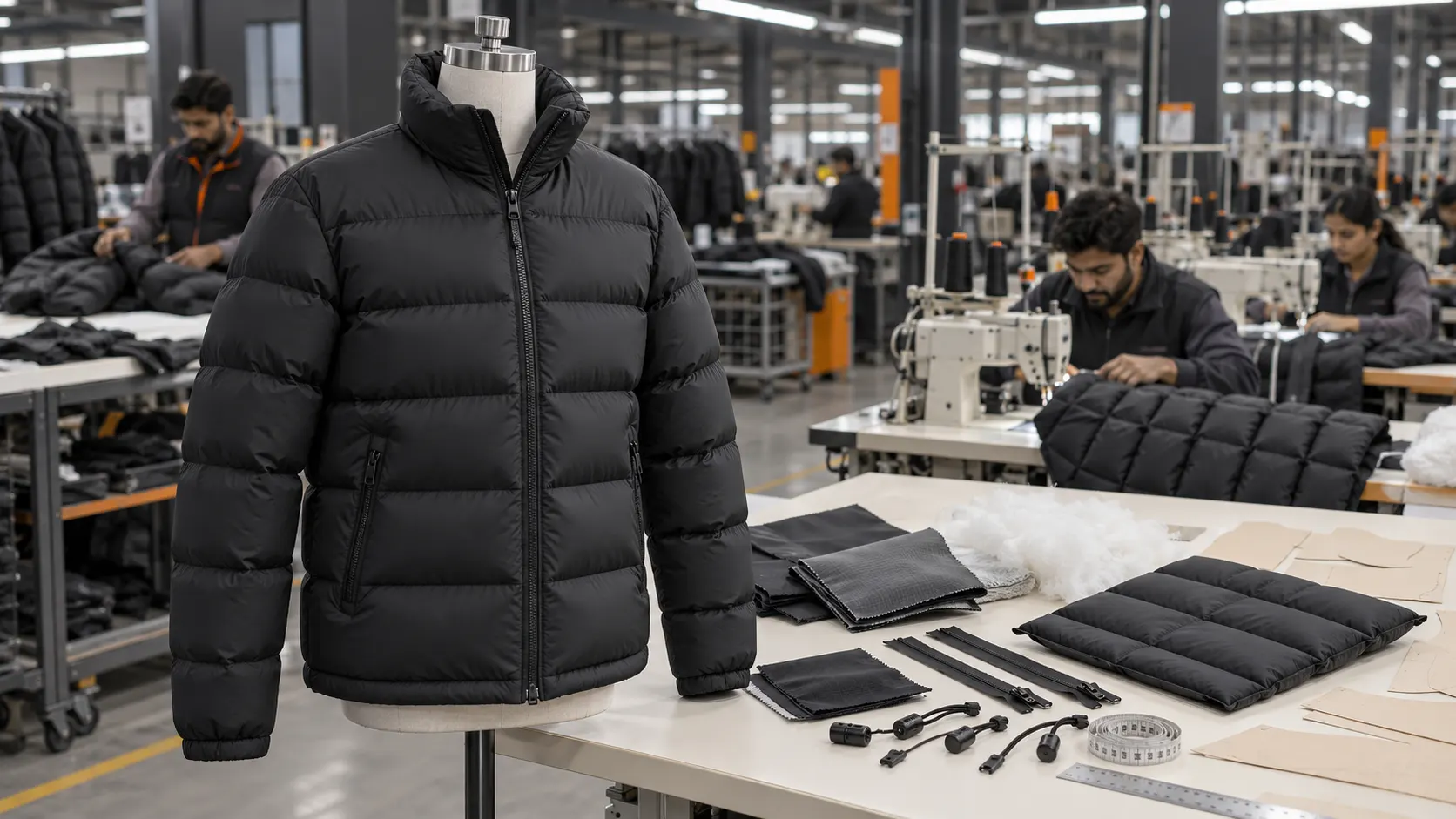
Custom Puffer Jacket Manufacturing for Clothing Brands
Stitch Expo develops custom puffer jackets for brands that need more than a stock insulated jacket with a logo added. A private-label programme can define the silhouette, shell fabric, insulation type and amount, baffle layout, lining, hood, collar, cuffs, hem, pockets, zipper system, artwork, labels and packaging.
Puffer jackets are technically different from simple shell jackets because the outer fabric, insulation and lining must function as one system. The pattern needs enough internal volume for the chosen fill without making the garment unnecessarily bulky, while quilting or baffle construction must control insulation distribution and preserve the intended silhouette.
Development can begin from a tech pack, reference sample, sketch, measurement chart or clear reference images. Sampling before bulk production allows the brand to review loft, fit, sleeve volume, hood shape, quilting scale, pocket position, hardware, branding and overall warmth direction as a complete garment.
How Is a Puffer Jacket Constructed?
A puffer jacket uses insulation trapped between an outer shell and an inner layer or lining. Quilted channels or baffles control that insulation so it stays distributed across the garment. The visible padded sections may be horizontal, vertical, geometric or custom shaped depending on the design and manufacturing method.
The shell protects the insulation and creates the external appearance. The insulation provides loft and thermal resistance. The lining finishes the interior and can improve comfort, durability and ease of dressing. Zippers, pocket bags, drawcords, elastic, snaps and reinforcement materials then need to be integrated without creating unnecessary bulk or weak points.
A lightweight city puffer, oversized streetwear puffer, cold-weather padded jacket and packable layer should not automatically use the same shell, fill amount, baffle size or pattern proportions.
Types of Custom Puffer Jackets We Can Develop
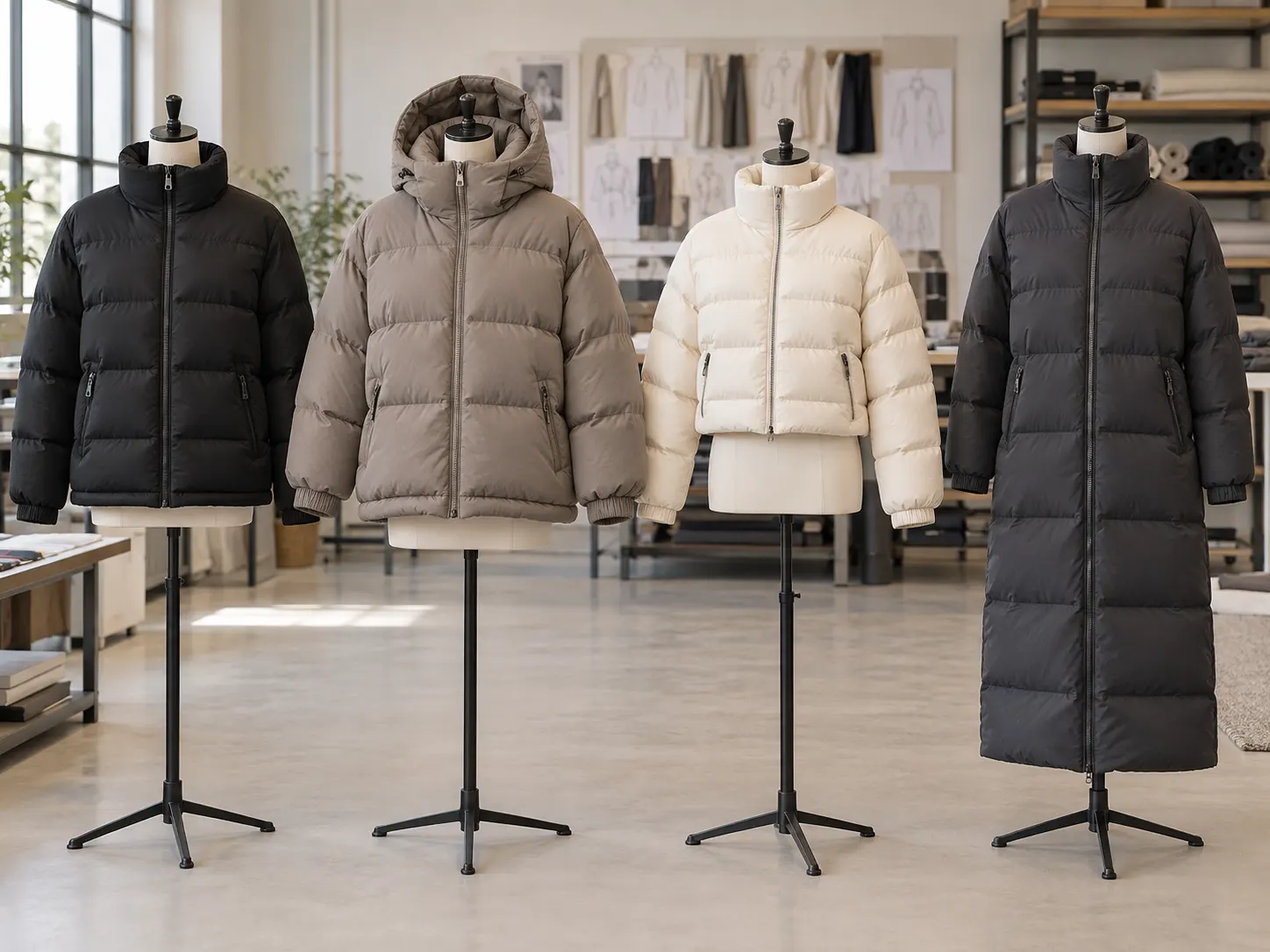
Puffer jackets can be developed around different climates, silhouettes and brand identities.
Classic Puffer
Regular-length insulated jacket with quilted body, front zipper and practical pockets.
Hooded Puffer
Integrated or detachable hood with controlled volume, adjustment and insulation.
Oversized Streetwear Puffer
Wider body, dropped shoulder and larger sleeve volume.
Cropped Puffer
Short fashion silhouette with balanced hem, baffle and pocket proportions.
Long Puffer / Coat
Extended coverage for winter collections and cold-weather outerwear.
Lightweight Puffer
Reduced bulk for layering, transitional seasons and travel.
Heavyweight Winter Puffer
Higher-loft construction developed around colder-weather requirements.
Puffer Vest / Gilet
Sleeveless insulated outerwear using the same shell and fill principles.
Reversible Puffer
Two-sided construction requiring careful seam, pocket and branding planning.
Shell Fabrics for Custom Puffer Jackets
The shell affects weight, hand feel, durability, wind resistance, water repellency, sheen and overall visual character. Fabric selection should be based on the intended product rather than GSM alone.
- Nylon and nylon-look woven shells
- Polyester woven shells
- Ripstop constructions
- Matte and low-sheen finishes
- Glossy fashion shells
- Lightweight downproof-style fabrics where appropriate
- Water-resistant finishes where required
- Recycled-material options subject to sourcing
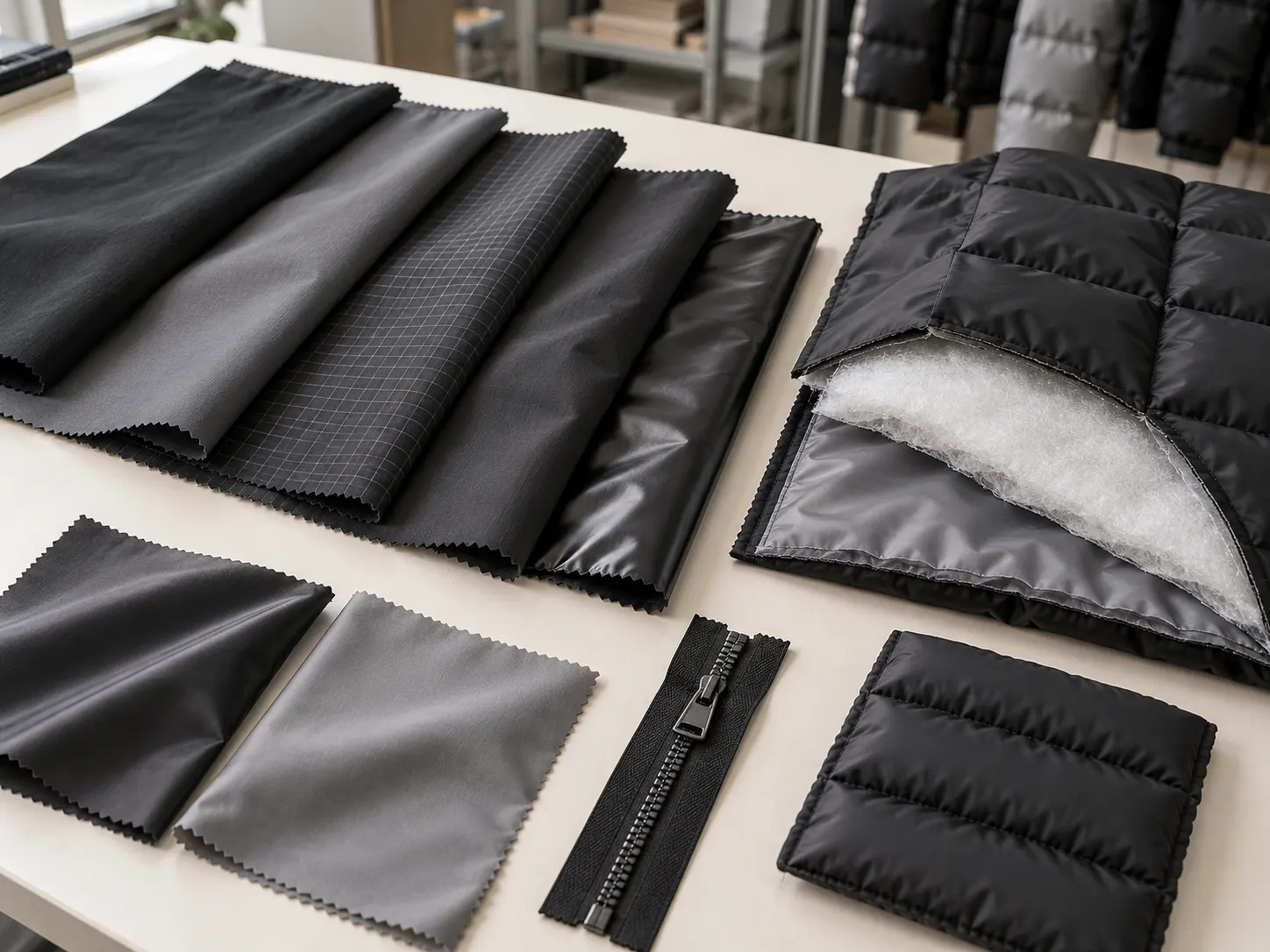
For insulated outerwear, shell selection also needs to consider stitch performance, fill containment, abrasion, coating or finish, and compatibility with printing or heat-applied branding.
Puffer Jacket Insulation & Fill Options
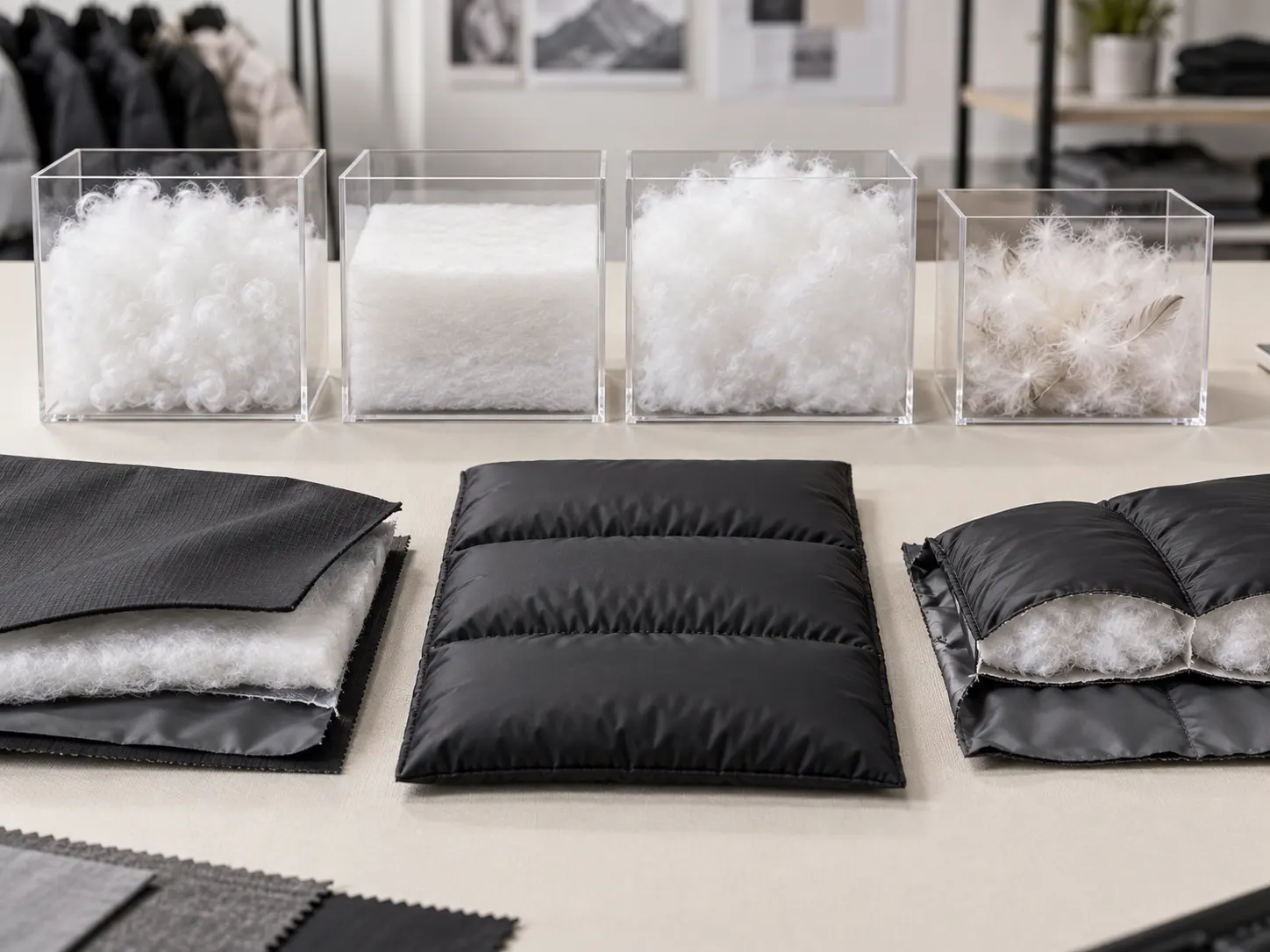
Insulation changes warmth, loft, compressibility, weight, care requirements and price. Synthetic insulation is widely used for custom fashion and team outerwear because it can provide controlled loft and practical care. Natural down may be considered for suitable projects when sourcing, construction, traceability and fill containment requirements are agreed.
- Synthetic polyester insulation
- Sheet or wadding-style padding
- Higher-loft synthetic fill
- Recycled synthetic options subject to sourcing
- Natural down/feather options for suitable programmes
- Different fill amounts by body, sleeve or hood
For down projects, fill power and fill weight describe different characteristics and should be considered with baffle volume and garment size.
Baffle Design, Quilting & Puffer Construction
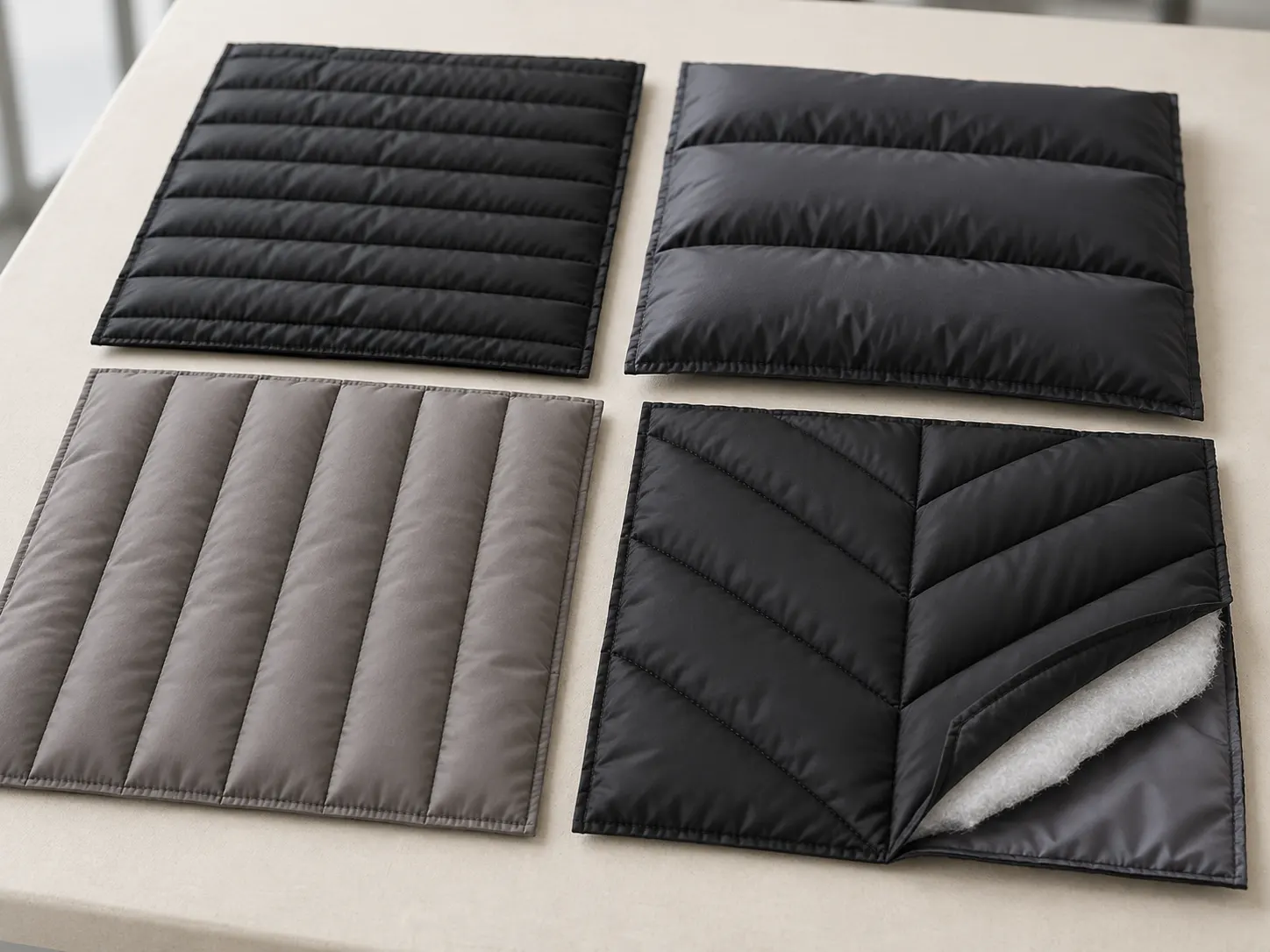
Baffle layout is both functional and visual. It controls insulation distribution and strongly influences the jacket's appearance. Narrow channels can create a compact look; larger chambers can create a pronounced high-loft silhouette.
Horizontal Channels
The recognizable puffer layout, with width and spacing adjusted to silhouette.
Vertical Quilting
Alternative line direction for selected panels or full-garment concepts.
Geometric Quilting
Diamond, chevron or custom directions where technically suitable.
Stitch-Through
Layers are quilted along defined lines to create controlled channels.
Higher-Volume Chambers
Construction developed for pronounced loft where required.
Mixed Panel Layouts
Different quilting scales across body, sleeves or hood.
Water-Resistant & Wind-Resistant Puffer Development
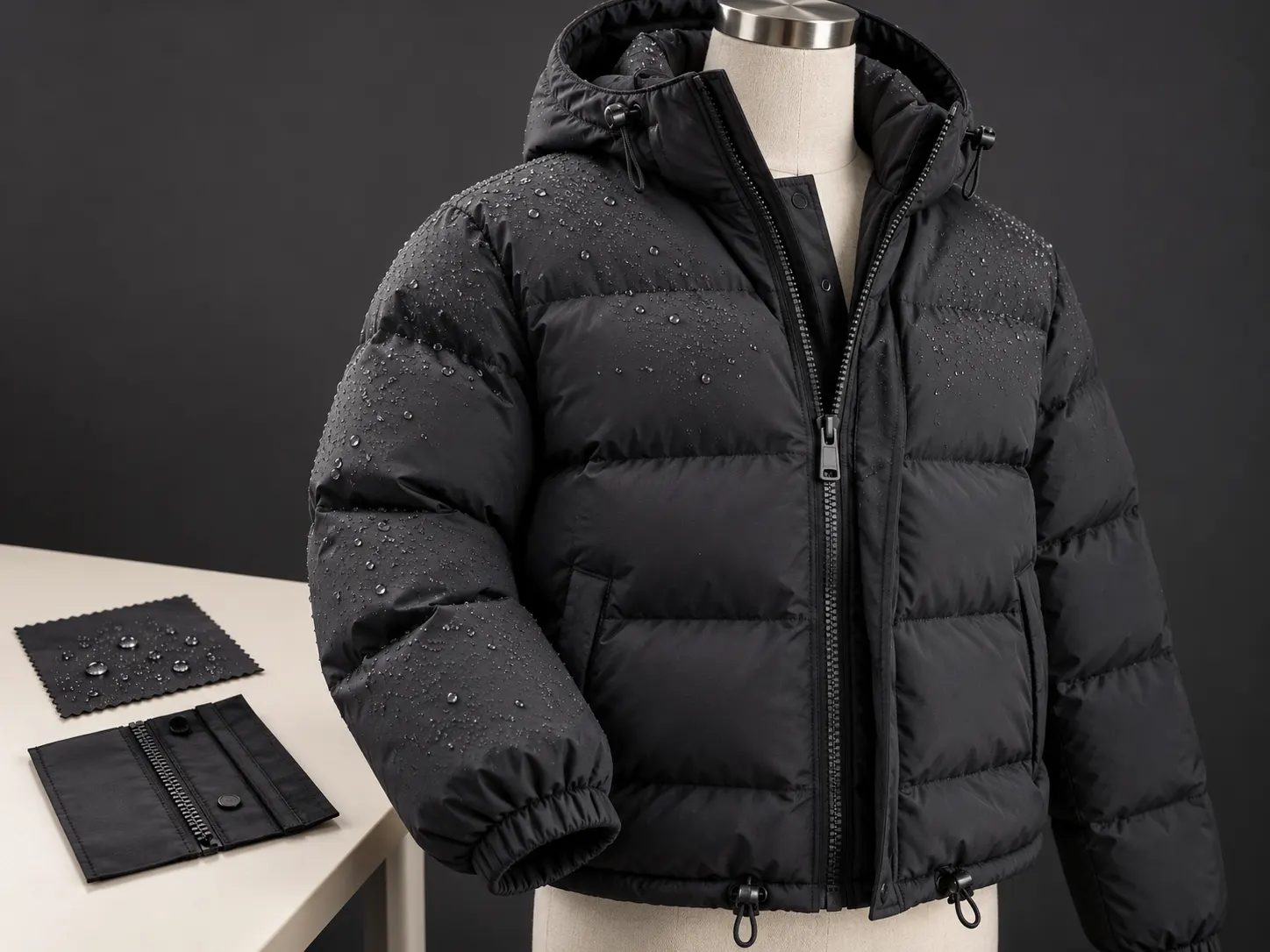
A puffer can be developed with shell fabrics and finishes intended to improve resistance to wind and light precipitation. However, a water-resistant shell does not automatically make the complete garment waterproof. Stitching, quilting lines, zipper construction, seams and openings all affect weather protection.
If a brand needs a defined waterproof or breathability performance level, that requirement should be specified before sourcing so appropriate fabrics, seam construction and testing can be considered. Fashion puffers and technical outdoor jackets may require very different construction strategies.
- Water-resistant shell options
- Wind-resistant woven shell directions
- Coated or finished fabrics where suitable
- Storm flaps behind front zippers
- Adjustable hems and hoods
- Elasticated or adjustable cuffs
Hoods, Collars, Cuffs & Adjustable Hems
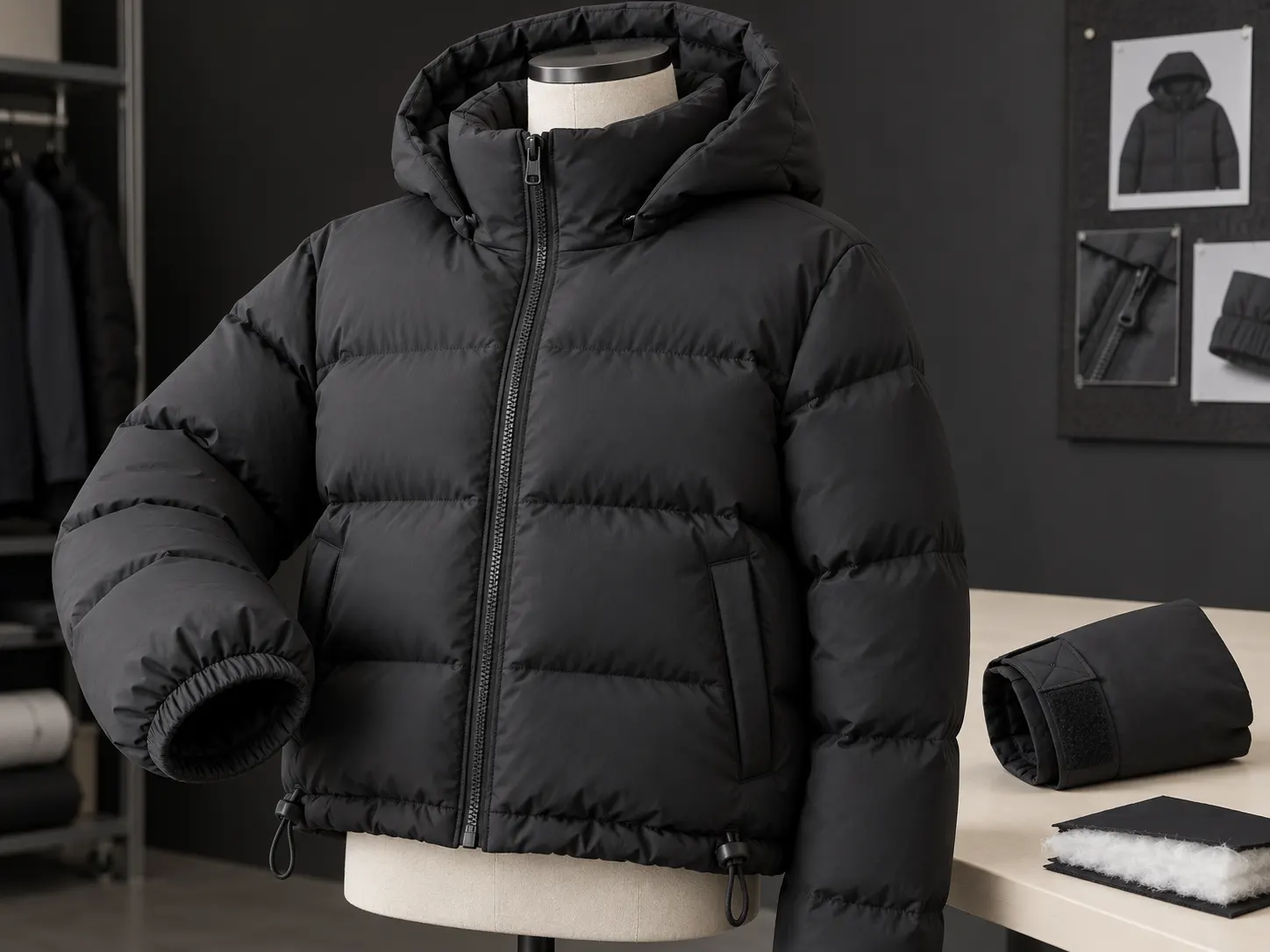
Openings are important to warmth and fit. A high collar can protect the neck; an insulated hood needs enough volume to sit naturally without pulling the neckline; cuffs and hems can help reduce unwanted air movement.
High Stand Collar
Lightly or fully insulated and developed to sit comfortably when zipped.
Fixed Hood
Integrated with controlled depth, opening and insulation.
Detachable Hood
Requires clean attachment hardware and neckline finishing.
Elastic Cuffs
Functional finish that helps control the wrist opening.
Adjustable Cuffs
Alternative adjustment for more technical directions.
Drawcord Hem
Allows adjustment of the bottom opening and silhouette.
Puffer Jacket Zippers, Pockets & Hardware
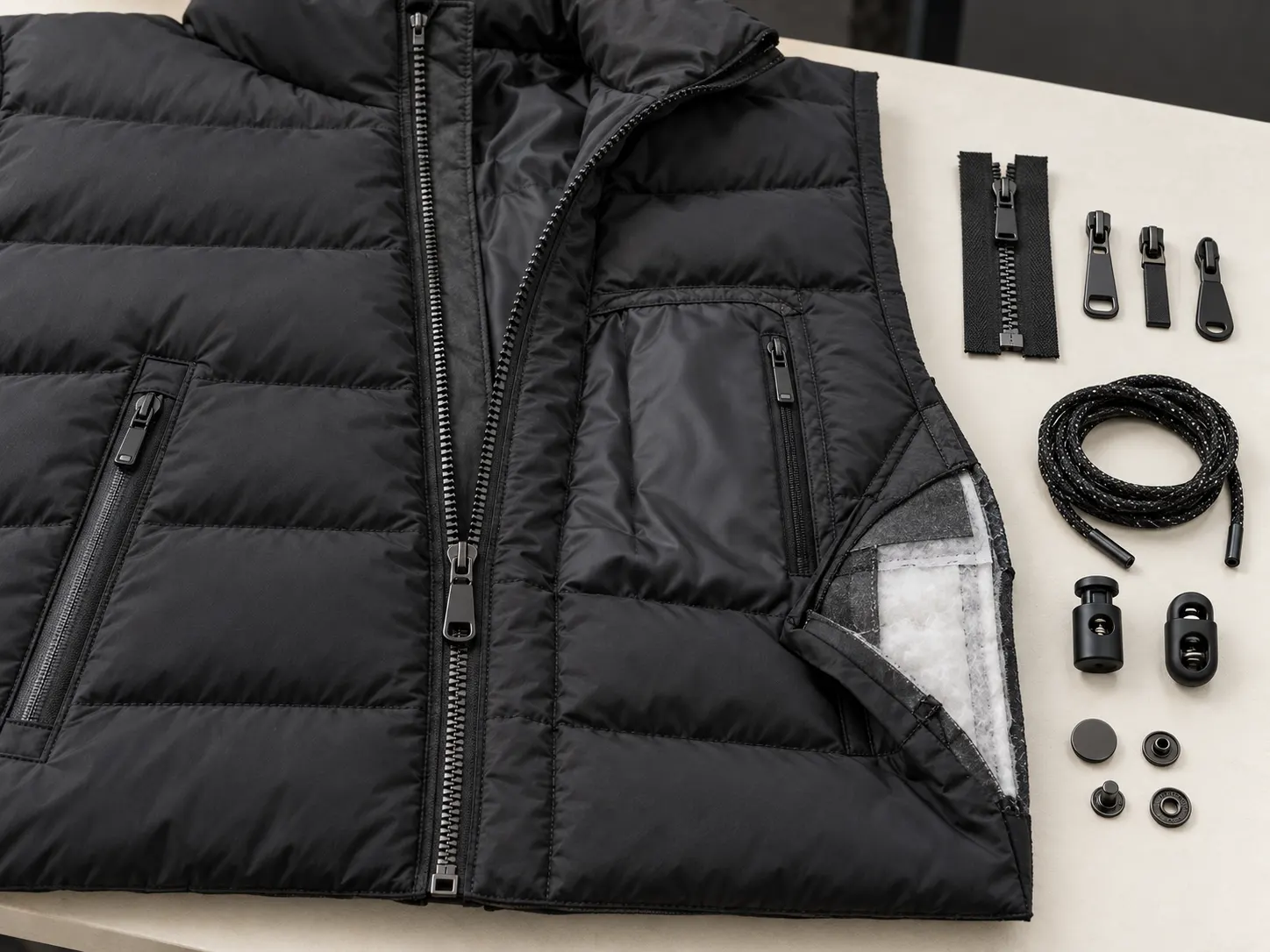
Hardware needs to function reliably through padded layers. Front zippers, pocket zippers, snaps, cord locks and pullers should be selected according to shell weight, jacket scale and intended aesthetic.
- Metal, molded or coil zipper directions where suitable
- One-way or two-way front zippers for selected styles
- Zippered side pockets
- Welt or concealed pocket constructions
- Internal security pockets
- Chest pockets
- Custom zipper pull directions subject to MOQ
- Drawcords, toggles and cord locks
- Snap closures and storm-flap details
Puffer Jacket Fit, Pattern Making & Size Grading
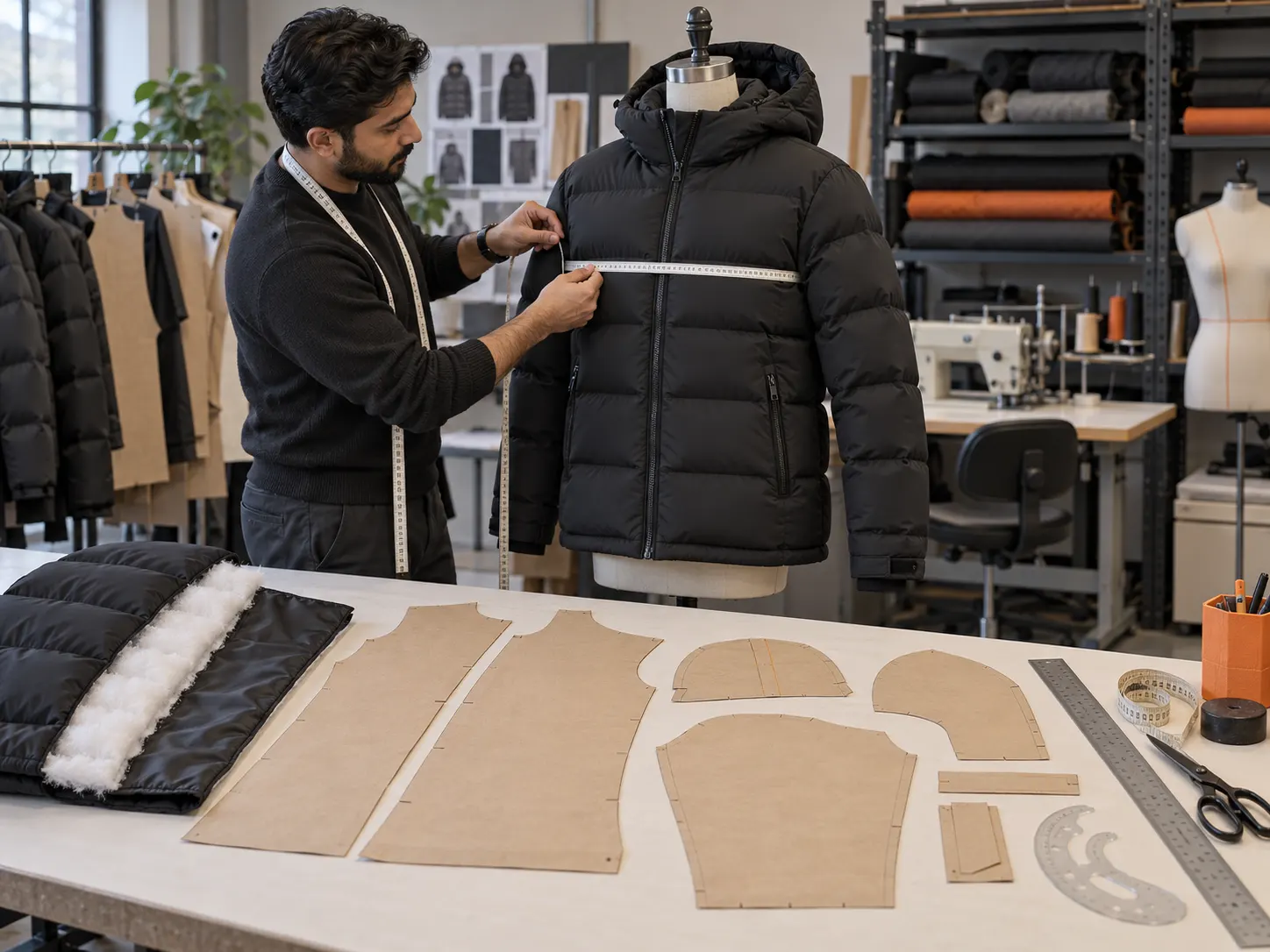
Insulation adds volume inside the garment, so a puffer pattern cannot be treated exactly like an unlined shell jacket. The pattern needs to account for fill thickness, intended layering, baffle construction and desired external silhouette.
Regular, relaxed, oversized, cropped and longline puffers each need different body and sleeve proportions. For oversized streetwear, simply grading a regular pattern several sizes larger can create poor shoulder, sleeve and hem relationships. The intended silhouette should be built into the base pattern.
- Chest and body width
- Body length
- Shoulder position/drop
- Armhole depth
- Sleeve length and volume
- Bicep and cuff opening
- Collar and hood dimensions
- Bottom opening
- Pocket position
- Finished measurements after insulation
Once approved, the base pattern can be graded for the required size range. See pattern making in clothing manufacturing.
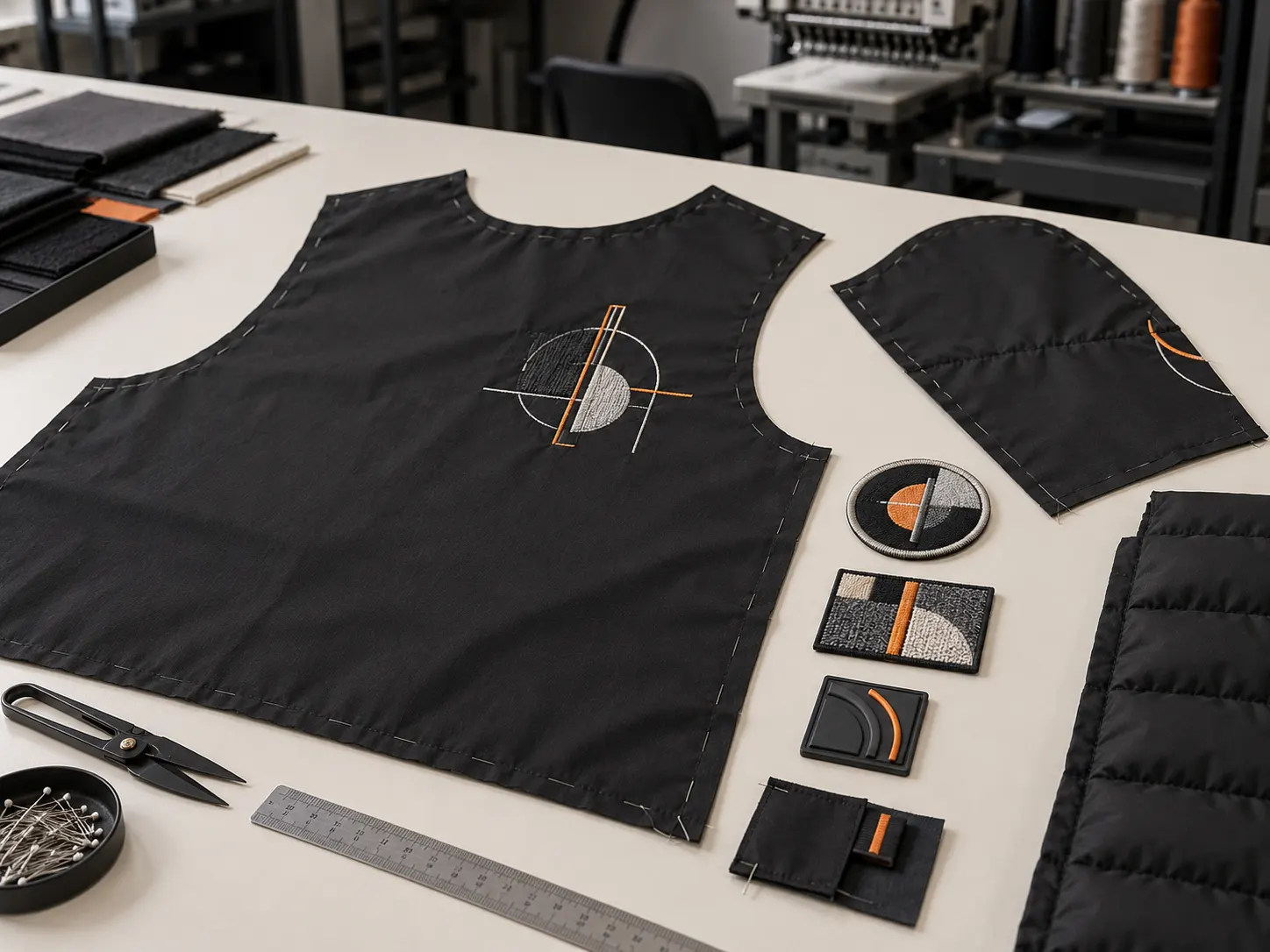
Embroidery, Printing, Patches & Branding on Puffer Jackets
Decoration on insulated garments should be planned before assembly. Direct embroidery through a finished puffer can compress insulation and expose stitching inside, so the production sequence and backing method need to suit the artwork and panel construction.
Flat Embroidery
Suitable for many chest, sleeve and branding applications when planned at panel stage.
Embroidered Patches
Separately developed badges with controlled attachment.
Woven Patches
Useful for finer artwork and compact branding.
Rubber / Silicone
Modern dimensional branding where material compatibility is suitable.
Printing / Transfers
Selected processes according to shell composition and heat sensitivity.
Custom Trims
Zipper pullers and woven tabs can extend identity beyond the main logo.
Private Label Puffer Jacket Manufacturing
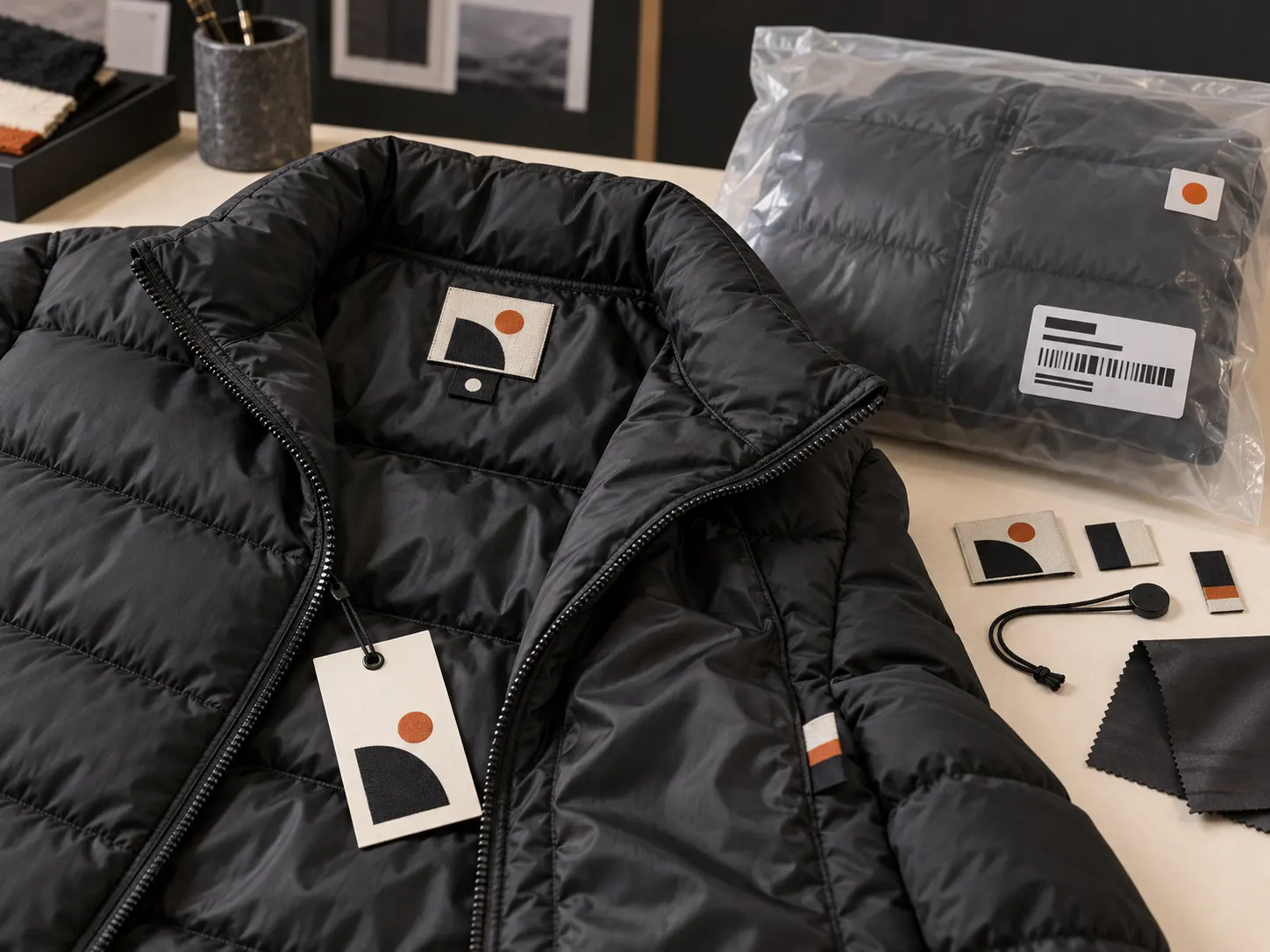
A custom puffer can be delivered as a complete private-label product ready for a brand's retail or distribution workflow.
- Custom woven neck labels
- Size labels
- Care and composition labels
- Hang tags
- Woven logo tabs
- Custom zipper-pull direction where feasible
- Size stickers and SKU identification
- Protective garment bags
- Bulk carton preparation
Care and composition information should match the actual shell, lining and insulation. See our custom clothing labels and packaging guide.
Custom Puffer Jacket Manufacturing Process
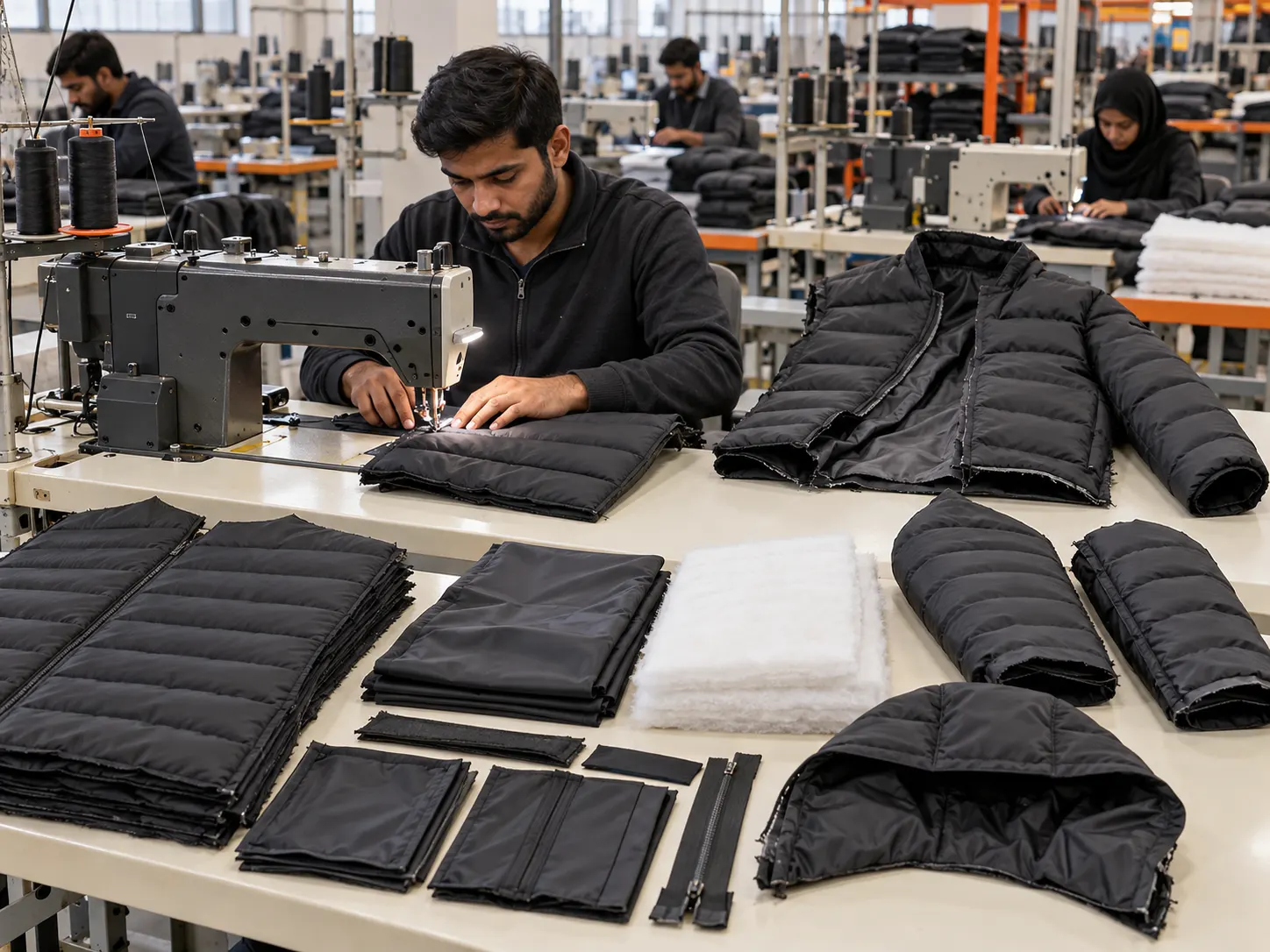
Puffer production requires insulation, shell and pattern to be controlled together. A sample-approved specification should guide bulk manufacturing.
Design & Brief
Review silhouette, climate, shell, fill direction, branding, quantity and use.
Tech Pack
Confirm measurements, baffles, hood, pockets, trims, labels and construction.
Material Sourcing
Select compatible shell, lining, insulation, zippers and supporting materials.
Pattern Development
Build the base pattern with allowance for insulation and intended layering.
Baffle Plan
Map channel widths and quilting lines to panels and pockets.
Sample Development
Construct a physical sample using intended materials and insulation.
Fit & Loft Review
Assess measurements, volume, hood, sleeves, hem and baffles.
Corrections & Approval
Update controlled specifications following sample feedback.
Grading & Marker
Develop approved size range and cutting layouts.
Cutting & Preparation
Cut shell, lining, insulation and reinforcement components.
Decoration
Apply embroidery, patches or suitable branding at the correct stage.
Quilting & Assembly
Create insulated panels and assemble body, sleeves, hood and closures.
Finishing & QC
Inspect measurements, fill distribution, quilting, zippers and seams.
Packing & Shipping
Apply branding, identify sizes, pack and prepare shipment.
Puffer Jacket Quality Control
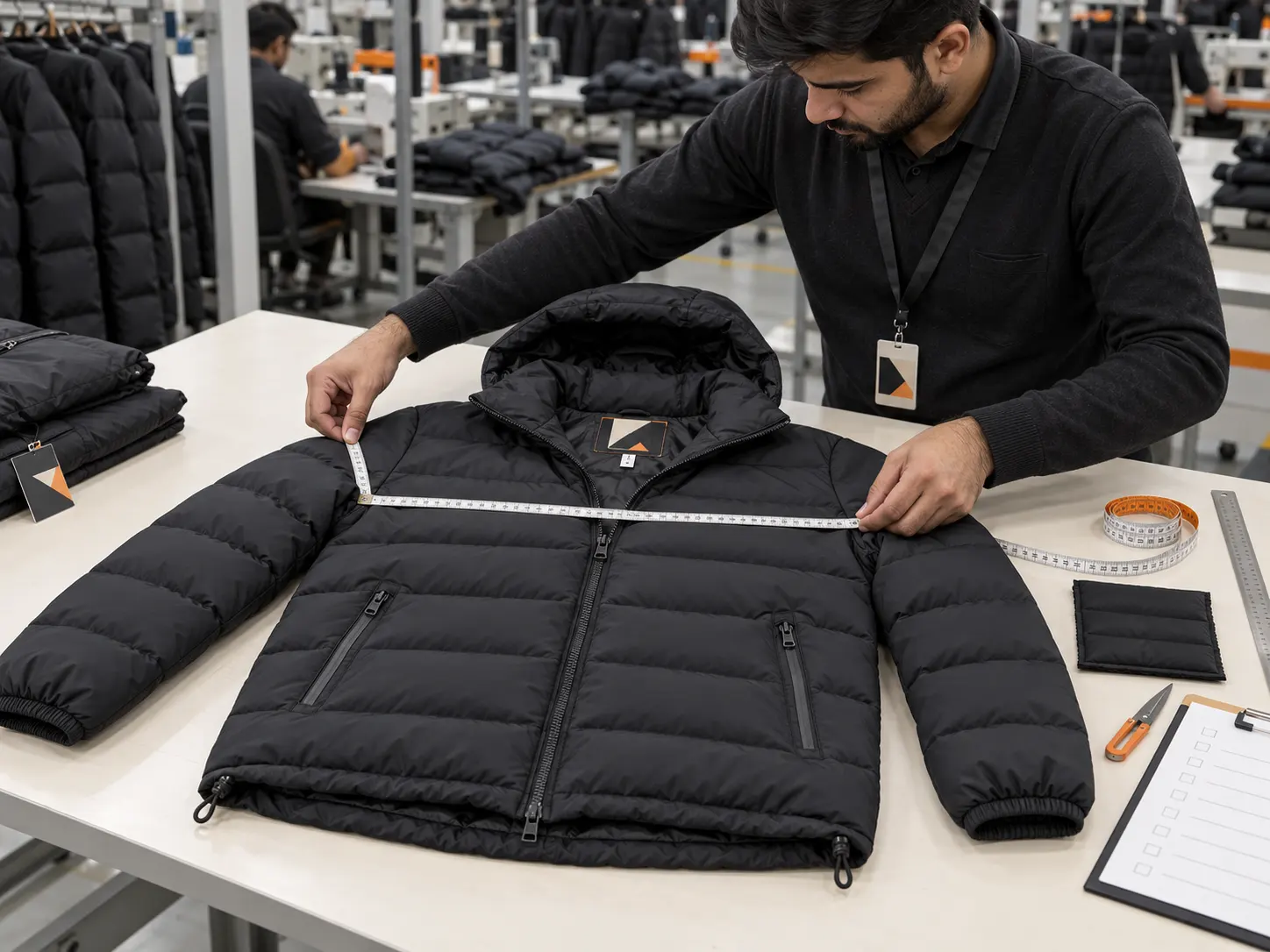
Quality control should assess both conventional garment workmanship and puffer-specific construction against the approved sample and specifications.
- Finished garment measurements
- Shell colour and shade consistency
- Quilting-line position and symmetry
- Baffle width and visual consistency
- Even insulation distribution and loft
- Cold or empty-looking areas caused by fill migration
- Front zipper operation and alignment
- Pocket position and function
- Hood and collar shape
- Cuff and hem function
- Seam and lining workmanship
- Decoration dimensions and placement
- Labels and size identification
- Loose threads, stains or surface damage
- Packaging and carton assortment
What Should You Send for a Custom Puffer Jacket Quote?
A detailed brief helps us evaluate material sourcing, insulation, construction and decoration accurately.
- Front, back and detail references
- Regular, oversized, cropped, long or vest style
- Shell fabric direction and colour
- Synthetic or down-fill preference if known
- Desired season and intended use
- Baffle or quilting layout
- Hood and collar requirements
- Cuff and hem construction
- Zipper and pocket details
- Measurements or intended fit
- Artwork files and placements
- Private-label requirements
- Size breakdown and quantity
- Packaging requirements
- Destination and target delivery date
MOQ, Sampling & Bulk Puffer Jacket Production
Puffer jackets use multiple material layers and can require custom shell colours, insulation, quilting, zippers and trims. Exact minimums and timelines depend on the specification and material availability.
Typical MOQ
Stitch Expo commonly works around 20–30 pieces per design for custom apparel projects where materials and trims permit. Exact puffer minimums are confirmed after design review.
Sample Development
Typical custom apparel samples can be around 7–11 working days once specifications and required materials are ready. Complex shells, trims or insulation can require longer.
Bulk Production
Typical custom apparel bulk production can be around 12–20 working days for suitable programmes, while complex insulated outerwear or larger quantities may require additional time.
Sample approval should cover fit, finished measurements, fill volume, baffle layout, hood balance, pocket access, zipper operation and decoration placement.
Who We Manufacture Custom Puffer Jackets For
Streetwear Brands
Oversized silhouettes, statement quilting and custom branding.
Fashion Labels
Cropped, longline, reversible and seasonal insulated outerwear.
Sports & Teamwear
Warm sideline, travel and staff jackets with practical branding.
Outdoor / Lifestyle
Shell, insulation and functional details developed around intended conditions.
Retailers & Wholesalers
Consistent sizing, private labels, SKU control and bulk packing.
Startup Brands
Sample-first development from a reference, sketch or tech pack.
Custom Puffer Jacket Manufacturing for International Brands
Stitch Expo works with custom apparel projects for customers in markets including the USA, United Kingdom, Canada, Europe, Australia and other destinations. International puffer programmes benefit from clear sample approval because shell colour, insulation volume, baffle construction and fit can be difficult to judge from a digital mockup alone.
Winter collections should be planned early enough for material sourcing, sample review, corrections, bulk production and international shipping. A lightweight urban puffer for a mild climate may require a very different specification from a higher-loft winter jacket.
Custom Puffer Jacket Manufacturer FAQs
What is a puffer jacket?
An insulated outerwear garment in which fill is controlled between shell and inner layers using quilted channels or baffles.
Do you manufacture fully custom puffer jackets?
Yes. Projects can define shell, insulation, lining, baffles, fit, hood, cuffs, pockets, zippers, branding, labels and packaging.
What is the MOQ?
Stitch Expo commonly works around 20–30 pieces per design where materials and trims permit. Exact puffer minimums depend on the specification.
Can you make oversized puffers?
Yes. Oversized proportions should be developed intentionally through the base pattern.
Can you make cropped puffer jackets?
Yes. Cropped puffers can use custom body length, baffle proportions, hem construction and fit.
Can you make long puffer coats?
Yes. Long insulated outerwear can be developed with custom length, hood, pockets and quilting.
What shell fabrics can be used?
Options can include nylon, polyester, ripstop and other suitable woven shells with matte, glossy or water-resistant finishes.
Do you offer synthetic insulation?
Yes. Synthetic insulation and wadding-style padding can be developed at different loft levels.
Can you manufacture down-filled jackets?
Down or down/feather construction can be considered for suitable projects when sourcing, fill specifications, containment, traceability and care requirements are agreed.
Can you make water-resistant puffers?
Yes, water-resistant shell directions can be developed. This does not automatically make the complete garment waterproof.
Can I choose the quilting pattern?
Yes. Horizontal, vertical, geometric and other suitable layouts can be developed.
Can you embroider puffer jackets?
Yes, but placement and production sequence should be planned around the insulated construction.
Do you provide labels and packaging?
Yes. Private-label programmes can include woven labels, care labels, hang tags, size stickers and packaging.
Can I order a sample first?
Yes. Sampling is recommended for reviewing fit, loft, materials, quilting, hardware and branding.
How long does a sample take?
Typical custom apparel samples can be around 7–11 working days once specifications and materials are ready; complex products can take longer.
How long does bulk production take?
Typical custom apparel bulk production can be around 12–20 working days for suitable programmes; complex puffer construction can extend this.
Can I send a tech pack or reference?
Yes. Tech packs, measurement charts, sketches, images and physical references can support development.
Do you ship internationally?
Yes. Stitch Expo works with international custom apparel projects and can arrange shipping according to order and destination.
Develop Your Custom Puffer Jacket With Stitch Expo
Send your tech pack, references, shell and insulation direction, quilting layout, measurements, branding, size range and quantity. We can review the project and help develop a production-ready private-label puffer jacket.