Stitch Expo Production Guide
Pattern Making in Clothing Manufacturing
Learn how garment patterns convert measurements, fit requirements and design intent into accurate, production-ready components.

Stitch Expo Production Guide
Learn how garment patterns convert measurements, fit requirements and design intent into accurate, production-ready components.
A garment pattern defines the shape, dimensions, balance, seam placement and construction information of each component. Accurate patterns help translate a design into a repeatable product that can be sampled, fitted, graded and manufactured.
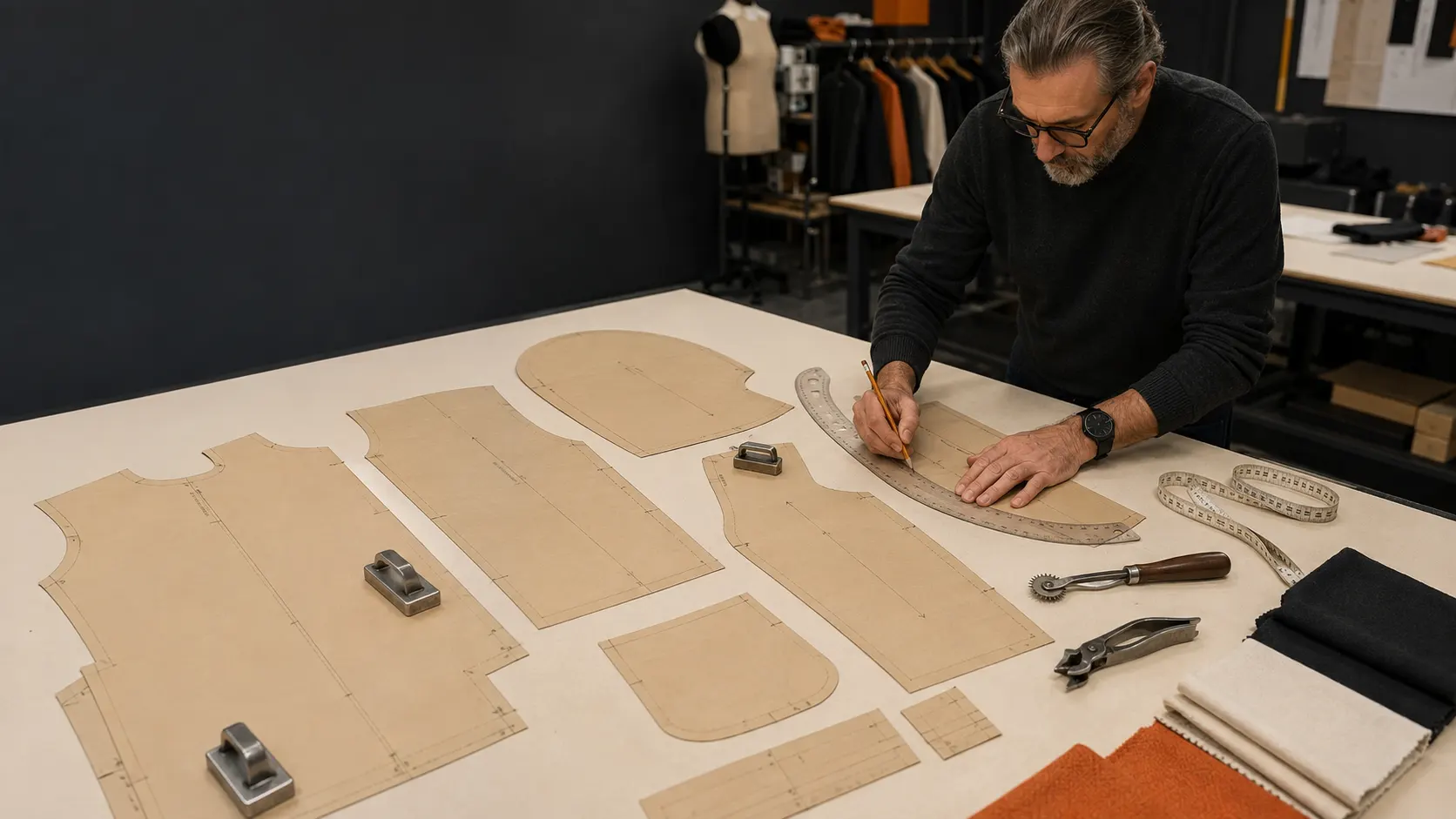
Pattern making is the technical process of creating templates for the individual pieces of a garment. These templates guide how fabric is cut before the components are assembled through sewing and other construction operations.
A pattern may include a front body, back body, sleeves, collar, cuffs, waistband, pockets, facings, linings and other components. Each piece must reflect the intended measurements, fit, silhouette, seam relationships and construction method.
Pattern making connects fashion design with garment engineering. A sketch can communicate appearance, but a pattern determines how that idea becomes a three-dimensional product that fits the body and can be reproduced during production.
A pattern influences much more than garment size. It affects balance, comfort, movement, seam alignment, appearance, material consumption and consistency between samples and bulk production.
Correct dimensions, shaping and ease help a garment fit the target customer and allow the intended movement.
Proportions, panel lines, pocket positions and silhouette are converted from the approved design into cuttable components.
Matching seam lengths, notches and assembly information help sewing teams join components correctly.
Production-ready pattern pieces can be arranged in a marker to manage fabric usage and cutting efficiency.
Approved patterns provide a controlled reference for producing consistent garments across an order.
Pattern measurements and approved samples give production and QC teams measurable standards to check.
| Pattern type | Purpose | Typical stage |
|---|---|---|
| Block or sloper | A basic fitted foundation without design styling, used as a starting point for development. | Foundation development |
| Drafted pattern | Created from measurements and calculations using flat pattern-making principles. | Initial development |
| Draped pattern | Developed by shaping material on a dress form before transferring the shapes to pattern paper or software. | Design development |
| First pattern | The initial interpretation of the design used to create the first physical sample. | Prototype sampling |
| Development pattern | Revised after fitting, construction review and design feedback. | Fit corrections |
| Approved or master pattern | The approved base-size pattern used as the controlled reference for grading and production preparation. | Pre-production |
| Graded pattern | A size range created from the approved base size using defined grade rules. | Size-set development |
| Production pattern | A final checked pattern containing the pieces and information needed for bulk cutting and assembly. | Bulk production |
Terminology can vary between factories, brands and software systems. The important point is to control which version is approved and ensure that production uses the correct revision.
Professional pattern development is iterative. A pattern normally changes as the design is sampled, fitted, corrected and prepared for production.
The pattern maker studies the sketch, measurement chart, construction notes, reference garments, fabric, trims, fit description and artwork placements. Missing or conflicting information should be clarified before development.
A suitable foundation is selected for the product category and target fit. The base size should match the brand's size chart and intended market rather than being chosen arbitrarily.
The pattern maker creates the required silhouette and components using flat drafting, block manipulation, draping, digital tools or a combination of methods.
Seam and hem allowances, notches, grainlines, drill points, fold lines, placement marks, piece names and cutting instructions are added according to the construction plan.
Joining seams, curves, walking measurements, symmetry and critical dimensions are checked before material is cut.
The sample room cuts and sews a prototype using the pattern. Suitable fabric is important because stretch, drape and thickness can change the result.
The garment is checked on a fit model, dress form or approved reference. Fit, balance, proportions, mobility, construction and measurements are evaluated.
Approved fit comments are translated into pattern changes. A new sample may be required until the design and fit meet the agreed standard.
Once the fit and construction are approved, the controlled base pattern is prepared for grading. Version control is essential at this stage.
The pattern is graded into the required sizes, checked through a size set where required, then finalized for marker making, cutting and bulk manufacturing.
A clear pattern communicates both shape and manufacturing information. Depending on the product and system, it may include:
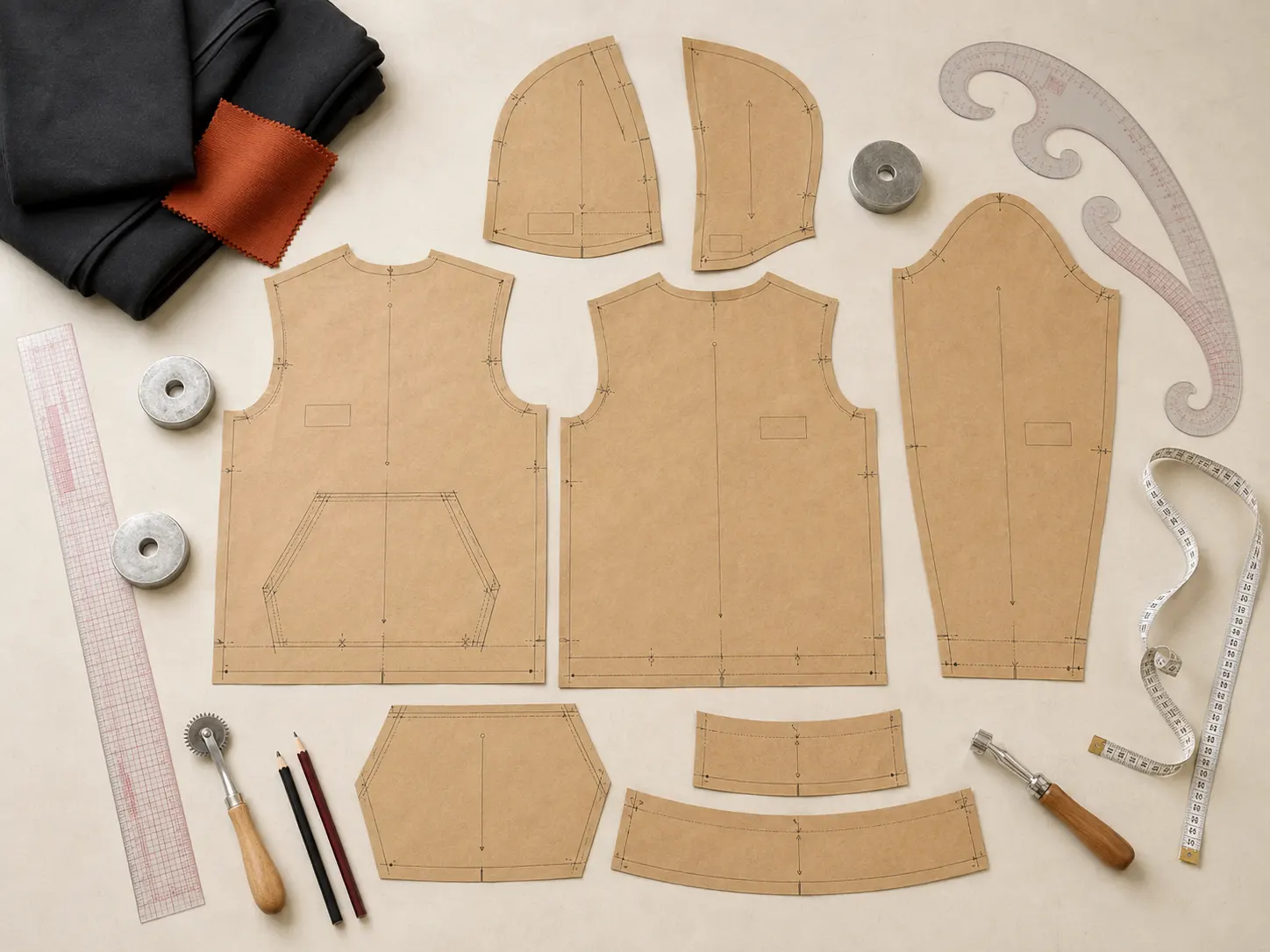
Flat pattern making uses measurements, geometry and an existing block or sloper to create two-dimensional pattern pieces. Darts, seams, shaping and style lines can be manipulated while maintaining the intended fit and volume.
Draping involves shaping fabric or a substitute material directly on a dress form. It is useful for complex volume, fluid silhouettes and designs whose three-dimensional form is difficult to resolve through flat drafting alone. The draped shapes are later converted into usable pattern pieces.
Computer-aided design systems allow pattern makers to draft, modify, measure, grade, nest and store patterns digitally. Digital tools improve revision control and data exchange, but software does not replace technical knowledge. Fit and construction decisions still require an experienced pattern maker and physical validation.
| Pattern making | Pattern grading |
|---|---|
| Creates and develops the shape and fit of the base-size garment. | Increases or decreases the approved base pattern to create additional sizes. |
| Interprets design, construction, body measurements and fabric behaviour. | Applies defined grade rules at selected points. |
| Is normally refined through samples and fittings. | Should be verified through measurements and, where needed, size-set samples. |
| Establishes the master pattern. | Builds the required size range from that master. |
Grading is not simply scaling the entire garment by one percentage. Different pattern areas grow by different increments to reflect the brand's sizing logic and target customer. Poor grade rules can make larger or smaller sizes disproportionate even when the base sample fits correctly.
A pattern cannot be evaluated independently from its intended material. Fabric composition, construction, weight, stretch, recovery, drape, shrinkage and finish influence dimensions and shaping.
Jersey, rib, fleece and French terry require attention to stretch, recovery, shrinkage, neck openings and seam behaviour.
Woven garments may require darts, seams, pleats or added ease because many woven constructions have limited stretch.
Compression, four-way stretch and engineered materials require testing for negative ease, opacity, recovery and movement.
Fabric should be tested in the condition that will be used for production. If the material or finished garment shrinks, the pattern and process may require compensation. The correct approach depends on whether the fabric is pre-shrunk, garment washed, heat set or treated after sewing.
Pattern orientation affects drape, stretch, stability and appearance. Grainlines, nap direction, one-way prints, checks, stripes and engineered artwork must be considered during pattern and marker preparation.
Before a pattern is released for production, the development team should verify the areas relevant to the garment:
The clearer the input, the more efficiently a manufacturer can develop the first pattern. A strong development package should include:
Questions Answered
Pattern making is the process of creating templates for every component that must be cut to construct a garment. The patterns translate measurements, fit, design and construction requirements into production-ready shapes.
Patterns control garment fit, balance, proportions, construction, material usage and production consistency. An inaccurate pattern can create problems even when the fabric and sewing quality are good.
A block or sloper is a basic fitted pattern used as a foundation for developing different styles. It normally contains essential shaping but not the complete design details of a finished style.
Pattern making develops the base-size garment shape and fit. Grading applies controlled increases and decreases to the approved base pattern to create the required size range.
Yes, an existing garment can be used as a reference, but accurate development still requires measurements, construction review and fabric consideration. The original garment should not be copied when the design or intellectual property is not authorized for use.
Not automatically. Digital systems improve editing, storage, measurement and grading efficiency, but accuracy still depends on the pattern maker's knowledge, correct input and physical fitting.
Every distinct style requires an appropriate pattern, but an existing approved block may be adapted when the category, fit and construction are compatible.
There is no universal number. Simple designs may be approved quickly, while complex garments or major fit changes can require several revisions. Approval should be based on results rather than a fixed sample count.
The base pattern is normally graded into the required sizes, checked, used for size-set or pre-production samples when required, and then prepared for marker making and bulk cutting.
Yes. Changes in stretch, shrinkage, weight, thickness or drape can affect fit and construction. A material change may require pattern adjustment and a new sample.
From Pattern to Production
Share your tech pack, measurement chart, reference garment or design details with Stitch Expo. We can review your product requirements and support the next stages of garment development, including pattern development, sampling and preparation for custom apparel production.